Conversations
Messages bound to any document, global or key of your own, with channels, threads, mentions and read state. Comments and reactions ship as extensions.
@10x-media/conversations adds conversations to Payload. A conversation belongs to a target: a document, a global, or a key of your own. Its messages live in channels, and each channel decides who reads and who writes. Threads are one level deep. Mentions go through a Lexical feature and end in a hook. Every user has their own read state, per channel and per thread.
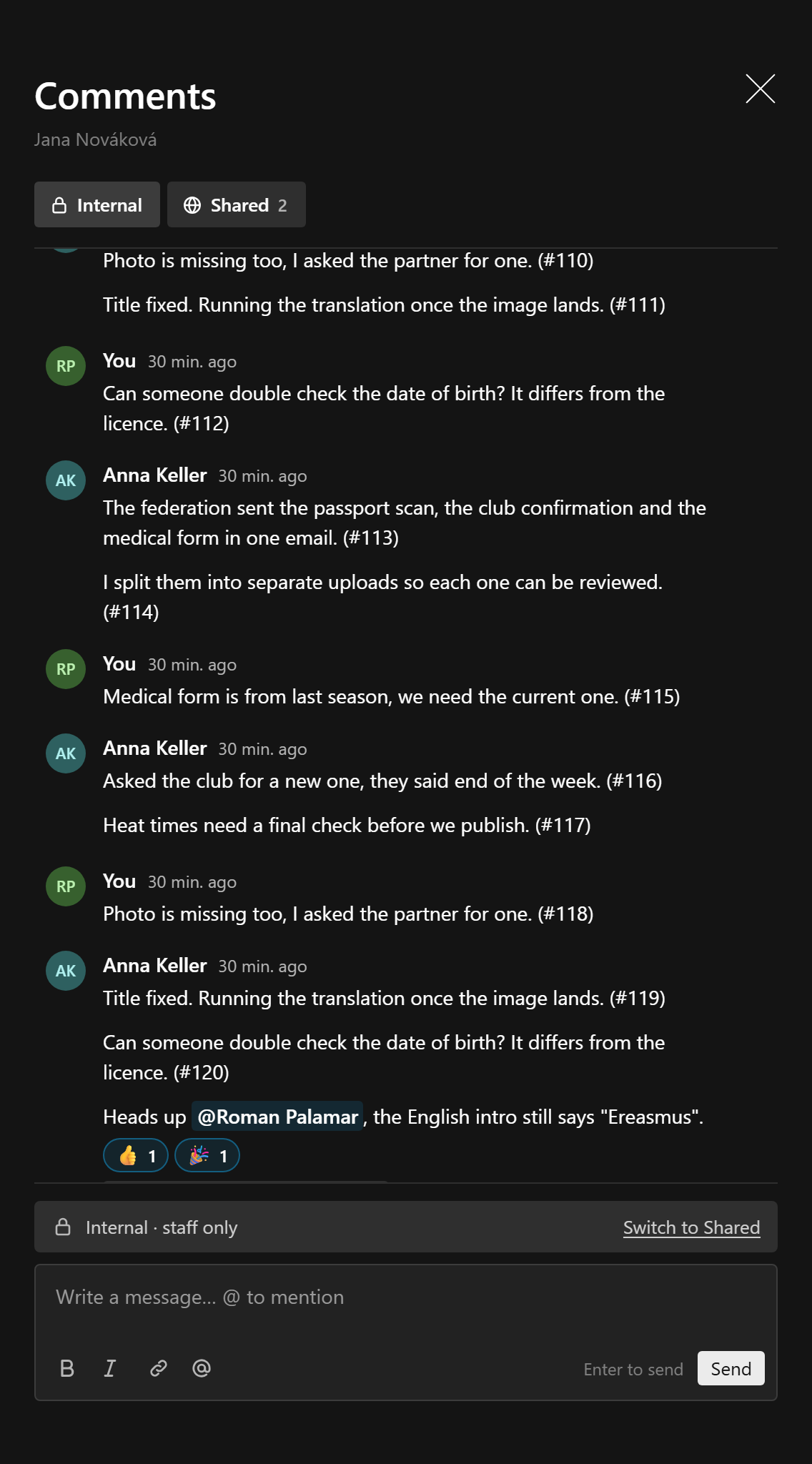
The core has no opinion on what a conversation is for. comments() turns it into a Comments button on edit views, reactions() adds emoji reactions, and attachments() files on messages. A support ticket system or a chat room is another configuration of the same core, with a view you compose from the admin components or, on a website, from the headless hooks and the shadcn registry.
import { conversations, perTarget } from '@10x-media/conversations'
import { comments } from '@10x-media/conversations/comments'

const isStaff = ({ req }) => req.user?.collection === 'users'

export default buildConfig({
  plugins: [
    conversations({
      slug: 'comments',
      access: perTarget(({ req }) => Boolean(req.user)),
      channels: [
        { slug: 'internal', label: 'Internal', access: { read: isStaff, create: isStaff } },
      ],
      extensions: [comments({ collections: { posts: true } })],
    }),
  ],
})
The model
- Instance. One
conversations()call, named byslug. It registers<slug>-messagesand<slug>-readsand serves its endpoints under/api/conversations/<slug>. Call it again for another use case:comments,tickets,chat. - Key. A conversation is a string:
collection:<slug>:<id>,global:<slug>orcustom:<anything>. The target holds no reference to it, so no field is added to your collections. - Channel. An attribute of each message, with its own access. A target offers the channels you list for it.
- Access. Conversation access answers for many targets in one batch, per target (every channel, some channels, or read only). Channel rules see only the user. Both collections are closed over REST; every read and write goes through the instance endpoints.
- Thread. A reply points at its root. Roots count their replies atomically on Mongo and Postgres.
- Read state. A cursor per user, conversation and channel, plus one per opened thread.
- Transport. How browsers learn that something changed: polling by default, Server-Sent Events, or a Pusher-compatible service.
- Extensions. Shape an instance, add per-message data, endpoints, stored fields, their part of a send, UI slots, composer addons and client data.
Entry points
| Import | Contents |
|---|---|
@10x-media/conversations | conversations, perTarget, defineMessageType, defineExtension, postMessage, touchMessage, getInstance, projectUsers, key helpers, transports and buses |
@10x-media/conversations/comments | comments() |
@10x-media/conversations/reactions | reactions() |
@10x-media/conversations/attachments | attachments() |
@10x-media/conversations/client | admin components on @payloadcms/ui |
@10x-media/conversations/react | headless provider and hooks, no @payloadcms/ui |
@10x-media/conversations/reactions/react | useReactions |
@10x-media/conversations/attachments/react | useAttachmentsComposer, useAttachments |
@10x-media/conversations/composer | the Lexical composer core, no @payloadcms/ui |
@10x-media/conversations/rsc | server components the plugin registers |
@10x-media/conversations/i18n | translation keys |
@10x-media/conversations/types | public types |
Where to go next
- Quick start: install, configure access and channels, and add comments.
- Concepts: instances, keys, channels, threads, read state and the data model.
- Access: grants per target, channel rules, read-only conversations, mentions, closed REST.
- Messages: sending, editing, deleting, custom message types, server helpers, hooks and endpoints.
- Rich text: the instance editor and composer features.
- Extensions: how they work, comments, reactions, attachments, and writing your own.
- Admin UI: the components, slots, replacing components, custom views and styling.
- Website UI: customer auth and the provider, the shadcn registry, and the headless hooks.
- Transport: polling, SSE with its buses, and Pusher.
- Recipes: support tickets, chat rooms, multi-tenant.
- Configuration: every option.
- Production notes: cascade, plugin order, database cost, limits.
- i18n: translate the UI and localize channel labels.